
Third-Party Hotel Management Comes of Age in Luxury
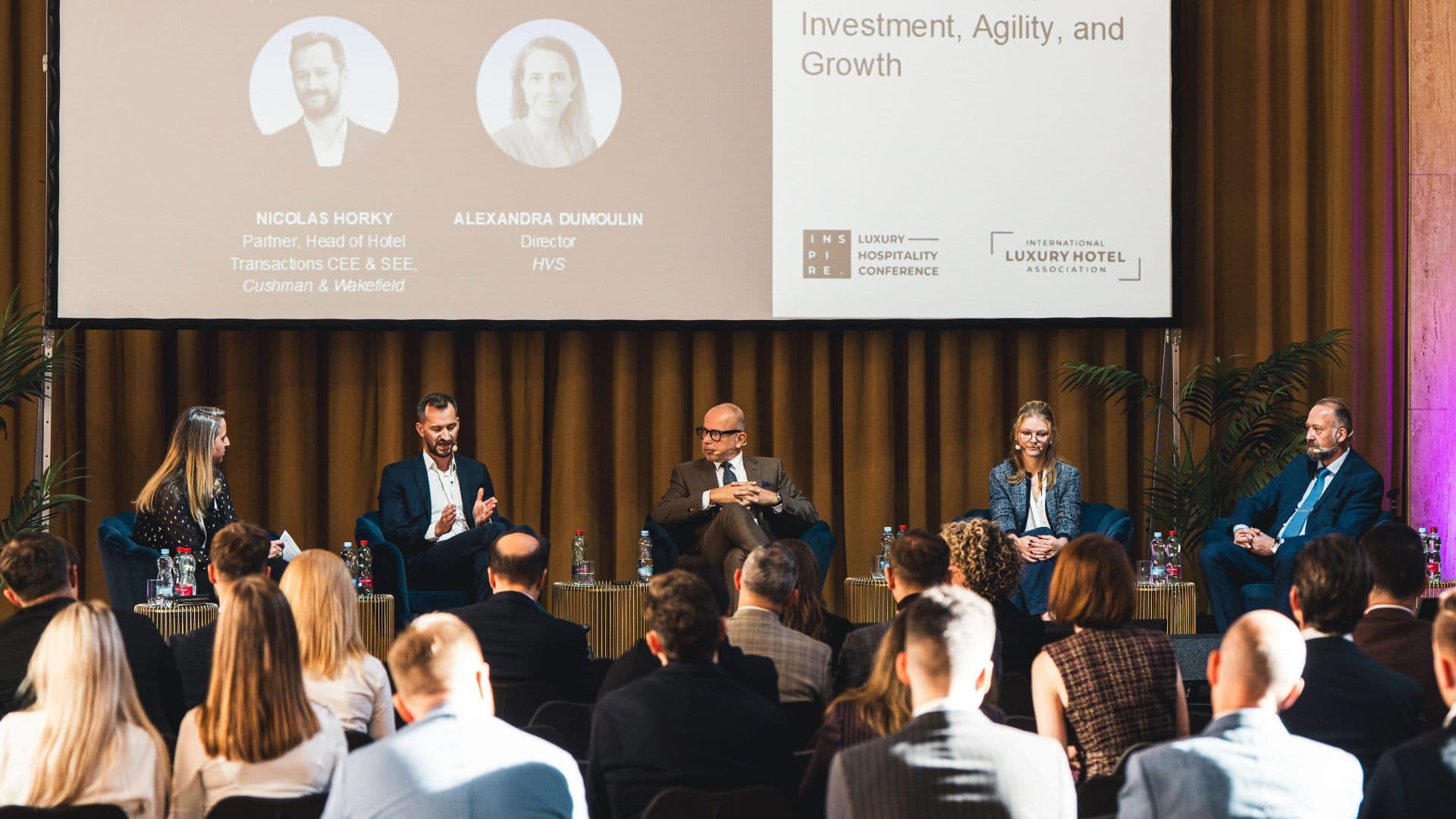
At the International Luxury Hotel Association’s conference at the Czech National Bank in Prague, a panel of brand leaders, investors, advisors, and operators explored why third-party management is becoming a more powerful force in luxury hospitality.
At this year’s International Luxury Hotel Association conference at the Czech National Bank in Prague, one of the clearest messages from the session on Third-Party Hotel Management: Investment, Agility, and Growth was that luxury hospitality is entering a more flexible era.
Moderated by Alexandra Dumoulin, Director at HVS, the discussion brought together perspectives from across the ownership, brand, advisory, and operating spectrum: Xavier Grange, Chief Development Officer, Sofitel, MGallery, Emblems Global & Luxe Europe; Ina Plunien, Vice President, Cedar Capital Partners; Nicolas Horky, Partner, Head of Hotel Transactions CEE & SEE, Cushman & Wakefield; and Armin Eberhard, Vice President Operations, Aimbridge EMEA.
What emerged was not simply an endorsement of third-party operators, but a broader recognition that the structure of hotel management in luxury is changing. Franchise models are gaining ground, soft brands and collections are opening new doors for conversions and heritage assets, and investors are demanding more flexibility than traditional long-term management agreements typically allow.
A structural shift in luxury
Dumoulin opened the conversation with data showing that luxury still accounts for a relatively small share of the overall hotel universe, yet franchise growth in the segment is accelerating faster than traditional management agreements. That trend is also increasingly visible in the development pipeline.
The implication was clear: while luxury was once seen as a category dominated by brand-managed assets, the model is evolving.
For Grange, that shift reflects a broader repositioning by major hotel groups. Rather than insisting on direct operational control in every case, many brands are now focusing more on what they do best: brand standards, distribution, and commercial power.
“We’ve moved from a world where brands wanted to manage everything. Today, brands are more focused on distribution and standards, and that opens the door for specialist third-party operators to run the asset.”
— Xavier Grange, Chief Development Officer, Sofitel / MGallery / Emblems Global & Luxe Europe
That change is particularly visible in luxury and lifestyle, where owners increasingly want operational partners that can adapt to the individuality of the asset while still leveraging the reach of a global brand platform.
Why collection brands are winning
One of the strongest themes throughout the session was the role of collection brands as an enabler of growth.
Rather than forcing every hotel into a rigid template, collection and soft-brand platforms give owners room to preserve a property’s personality, architecture, and story. That is especially valuable for historic buildings, conversions, and repositionings—precisely the kinds of assets increasingly shaping luxury supply in Europe.
“Collection brands give owners much more flexibility — especially for conversions — while still connecting the hotel to the brand’s distribution engine.”
— Xavier Grange, Chief Development Officer, Sofitel / MGallery / Emblems Global & Luxe Europe
Eberhard reinforced that point from an operator’s perspective, noting that hard brands can be restrictive when owners are trying to retain defining elements of a building. In contrast, collection brands often allow the operator to interpret the property in a way that feels authentic to the asset and the destination.
That combination—local character plus global distribution—was repeatedly framed as one of the central reasons third-party management has become more relevant in luxury.
The operator as translator between owner and brand
Another idea that resonated across the panel was the role of the third-party operator as an interface between owner and brand.
Eberhard described operators as the party responsible for translating the owner’s commercial ambitions into day-to-day execution while also meeting brand expectations. In practice, that means balancing asset-level profitability, service delivery, staffing, systems, and brand compliance—all while maintaining continuous dialogue with both sides.
That intermediary role is becoming more valuable as owners grow more sophisticated and more focused on returns. For investors, especially those with defined hold periods or clear exit strategies, operational alignment matters just as much as brand affiliation.
Ina Plunien emphasized that many large brand companies have shifted their core focus toward brand expansion and distribution, creating a gap between brand strength and asset-level profit optimization. Third-party managers, she suggested, are increasingly stepping in to fill that gap.
For owners, the appeal is not theoretical. It is about control, flexibility, and bottom-line performance.
Flexibility is no longer optional
If one topic united the investor and transaction perspectives on the panel, it was flexibility.
Horky made the point directly: long, rigid management agreements can materially affect liquidity on exit. Assets encumbered by inflexible contracts often attract fewer buyers, weaker bidding tension, and lower values. By contrast, franchise-plus-third-party-management structures can preserve optionality and make a property easier to sell.
In today’s market, termination rights, notice periods, and contract clarity are no longer secondary legal points. They are central to value protection.
Panelists noted that owners are increasingly willing to absorb the added cost of both franchise fees and third-party management fees in exchange for greater control and clearer exit pathways. In many cases, that flexibility is now being priced into deals as a form of risk management.
As Grange observed, even brand contracts are becoming more responsive to this reality, with shorter terms and more clearly defined termination mechanics than were common a decade ago.
Does the guest notice?
An important question raised during the session was whether guests can tell the difference between a hotel managed directly by a brand and one operated by a third party under franchise.
The panel’s consensus was that they should not.
So long as brand standards, audits, quality assurance, and service philosophy are rigorously enforced, the customer experience should remain consistent. Grange and Eberhard both stressed that the guest-facing outcome must be seamless, regardless of the operating structure behind the scenes.
That point matters in luxury, where owners and brands alike have historically worried that franchising could dilute service delivery. The panel largely argued the opposite: if the right operator is in place, and the brand maintains discipline around standards, third-party management can be invisible to the guest.
Lenders are looking at risk differently
The panel also turned to financing, where a post-Covid recalibration is reshaping how lenders assess hotel deals.
Horky noted that the conversation has shifted away from pure loan-to-value metrics and toward debt service coverage ratio (DSCR) and operational resilience. Cash flow durability, not just asset value, is now central to underwriting.
That shift creates a more nuanced view of third-party operators. On one hand, a strong operator may improve performance, control costs, and enhance cash flow. On the other, lenders still take comfort from the stability and demand engine associated with major global brands.
The takeaway was not that one model universally wins, but that the capital stack is becoming more sophisticated. Owners, lenders, brands, and operators all need to understand the rationale behind the chosen structure—and how it supports both ongoing operations and future exit value.
Growth across Europe—and beyond
On the question of where third-party management is likely to grow next, the panel pointed to continued momentum across Europe, especially in markets where branded infrastructure is expanding and owners are seeking more adaptable structures.
More mature markets remain highly competitive, but emerging and fast-evolving markets in Central and Eastern Europe also present opportunities, particularly where owners want the power of an international brand without the rigidity of a traditional management model.
The panel also noted that the trend is no longer confined to Europe. Third-party luxury management, long established in the United States and increasingly visible across Europe, is now pushing further into the Middle East and Asia-Pacific as owners become more comfortable with the model and specialist operators build scale.
A more nuanced future for luxury operations
The Prague session made one thing clear: the rise of third-party management in luxury is not about replacing brands. It is about redefining roles.
Brands remain critical for standards, distribution, loyalty, and positioning. But owners increasingly want operating structures that are more agile, more asset-specific, and more aligned with investment strategy. Third-party managers are stepping into that space as specialist execution partners—particularly in collection-brand, conversion, and luxury lifestyle environments.
As the market becomes more sophisticated, success will depend less on ideology and more on fit: the right brand, the right operator, the right contract, and the right asset strategy.
Or, as Grange put it:
“Brands don’t put the same pressure on owners to manage everything anymore — and that’s why we’re seeing so much momentum around collection brands and third-party operators.”
— Xavier Grange, Chief Development Officer, Sofitel / MGallery / Emblems Global & Luxe Europe
In luxury hospitality, third-party management is no longer a niche alternative. It is increasingly part of the mainstream conversation about growth, investment, and long-term value creation.